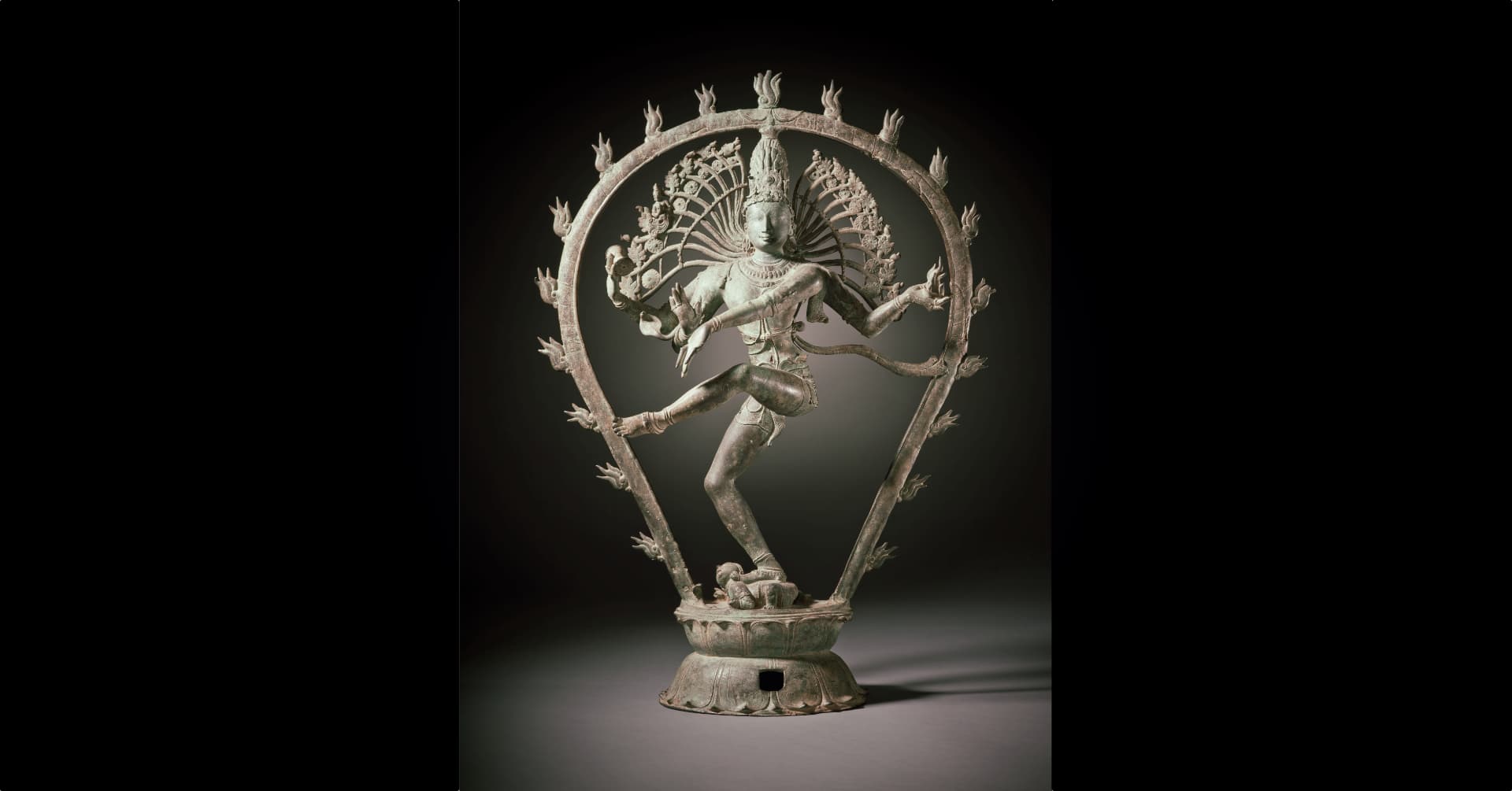
Shiva as the Lord of Dance, circa 950-1000, Los Angeles County Museum of Art
Shiva dances.
Not for joy, not for sorrow, not because he’s moved by emotion. He dances because the universe requires it. Because existence IS dance. Because consciousness in motion creates, sustains, and dissolves all worlds.
Tandav - the dance that ends cycles and begins them, that appears violent but is actually the most precise choreography in existence. This is not performance you watch from outside. This is the rhythm you ARE, whether you know it or not.
Every heartbeat is tandav. Every breath is tandav. Every moment of your life arising and passing away - this is Shiva dancing through your very existence.
What Tandav Actually Is
Tandav is the rhythm of reality itself. The pulsation that never stops. Creation expanding, preservation holding, destruction dissolving, concealment forgetting, grace remembering - these five movements happening constantly, at every level, in every moment.
As deity, Shiva performs this dance in subtle dimensions beyond ordinary perception. When he beats his damaru, the rhythm emerges. When he moves his body, reality follows. His dance IS the cosmic process. Not symbolizing it - BEING it. The universe dances because Shiva dances. If he stopped, everything would return to unmanifest void instantly.
But step deeper. This same dance is happening in your direct experience right now. Thoughts arising (creation), thoughts persisting (preservation), thoughts dissolving (destruction), the gap between thoughts where you forget yourself (concealment), awareness noticing the gap (grace). Your breath moving in and out. Your heart contracting and expanding. Cells being born and dying by the millions every second.
All tandav. All the same rhythm. Shiva’s cosmic dance and your human experience - not separate processes but one movement at different scales.
Most people live this dance unconsciously, being danced by forces they don’t understand. But you can learn to dance consciously, to move with the rhythm rather than against it, to know yourself as both the dancer and the dance.
The Forms of the Dance
Shiva’s dance has many expressions, each serving different cosmic functions:
Ananda Tandava - when consciousness experiences its own nature as infinite bliss. Pure celebration of being. Not celebrating something but celebrating existence itself. Have you ever felt joy for no reason? Ecstasy without cause? That’s ananda tandava moving through your system.
Sandhya Tandava - performed at twilight, the liminal time between day and night. This is the dance of transformation, of moving from one state to another. Every transition in your life - childhood to adulthood, single to married, one job to another - is sandhya tandava. The dance that happens in the space between what was and what’s becoming.
Rudra Tandava - wild, untamed, the storm god unleashed. Shiva dancing as raw force of nature that cannot be controlled or predicted. When passion overwhelms you, when energy surges beyond your capacity to direct it, when life becomes too intense to manage - that’s rudra tandava. Not chaos but power beyond ordinary containment.
Samhara Tandava - the dance of dissolution. This is what people fear most, what looks most violent, but is actually the most compassionate. When forms have become rigid, when patterns no longer serve evolution, when structures trap rather than support - samhara tandava dances them back to formless potential so new creation can emerge.
Each form serves the whole. Each expresses consciousness knowing itself through different qualities of movement. And each is available to you when the moment calls for it.
Why Destruction Is Actually Liberation
Here’s what confuses people about tandav: Why does divine consciousness dance destruction? Isn’t destruction the opposite of spiritual love and compassion?
This misunderstands what destruction means in cosmic terms.
Nothing is ever actually destroyed, only transformed. What gets “destroyed” in tandav is form, structure, pattern that has become limitation rather than expression.
Think about your own life deeply. That relationship that ended - it had to end. It was suffocating you, preventing growth, keeping you small. The destruction was mercy, even if it didn’t feel that way.
That belief system that shattered when you began spiritual seeking - it was imprisoning you in narrow concepts of reality. The destruction freed you to discover something vaster.
That identity you lost during crisis or awakening - it was false anyway. The destruction revealed what was always true underneath.
Shiva’s destruction is not violence but liberation. The ending of what needs to end so what needs to begin can begin. The dissolution of form so consciousness can know itself more fully.
As deity, when Shiva dances samhara tandava, he’s ending cosmic cycles that have served their purpose, dissolving universes that have completed their function, clearing space for fresh manifestation. Not from cruelty but from wisdom. Not from anger but from compassion that’s willing to let things die when death serves life.
And in your personal experience, when life dances destruction through your circumstances - job loss, relationship ending, health crisis, identity dissolution - this is the same dance at intimate scale. Trust it. Let it do its work. What survives the dance was real. What doesn’t survive needed to go.
The Nataraja Form: The Complete Teaching
The most famous image of Shiva dancing - Nataraja, Lord of the Dance - encodes the entire cosmic process in visual form.
See him standing within a ring of flames? That’s the universe itself, all of manifestation contained within cosmic fire. Everything that exists is within that circle. Everything is burning, transforming, dancing. And Shiva dances at the center, both within creation and as the consciousness that allows creation to occur.
His upper right hand holds the damaru - creation beginning with sound. His upper left hand holds flame - destruction completing the cycle. Same deity, same moment, holding both birth and death. Not sequential but simultaneous. In every instant, something is being created and something is being destroyed. This is the rhythm of existence.
His lower right hand shows abhaya mudra - “fear not.” Even though this dance destroys, even though it transforms, even though it can look terrifying - don’t be afraid. The consciousness behind the dance is benevolent. The destruction serves evolution. Trust the process.
His lower left hand points toward his raised foot - “here is liberation.” The foot lifted in dance represents freedom, transcendence, release from the wheel of becoming. But notice - the foot is raised in the dance, not by stopping the dance. Liberation is not escape from existence but conscious participation in existence.
His grounded foot stands on Apasmara - the demon of ignorance, unconsciousness, forgetting. Shiva’s foot keeps ignorance subdued but doesn’t kill it completely. Why? Because if ignorance were totally eliminated, the universe would end. Maya would dissolve. The play would be over. So ignorance is controlled, managed, kept from overwhelming, but not destroyed. This allows the dance to continue while consciousness remains awake within it.
And see his face - he’s smiling. Peacefully. Blissfully. While dancing destruction, while standing on ignorance, while the cosmos burns around him. Because from his perspective, this is all play. All lila. All consciousness knowing itself through infinite forms and their dissolution.
This is what tandav teaches: you can be fully engaged with life’s dance while knowing it’s all temporary. You can feel everything deeply while remaining free. You can participate completely while understanding it’s all divine play.
The Five Movements in Your Life
The rhythm Shiva dances has five beats that repeat constantly:
Srishti - creation, manifestation, new beginnings. When new relationships start, when projects launch, when ideas emerge, when life expands into fresh possibilities. Feel this movement in your experience. The excitement of starting, the energy of emergence, the joy of something new being born.
Sthiti - preservation, maintenance, holding what exists. When you’re in stable phase, when things continue, when patterns repeat, when life has rhythm and predictability. This isn’t boring - this is the dance maintaining what it has created, sustaining manifestation, allowing development within form.
Samhara - destruction, dissolution, endings. When relationships end, when phases complete, when old forms break down to make space for new ones. This feels difficult because ego identifies with forms, but it’s natural rhythm. Necessary for evolution. Liberation disguised as loss.
Tirobhava - veiling, concealment, forgetting true nature. When you lose touch with deeper reality, when you get caught in drama, when consciousness forgets itself and identifies with limited forms. This seems like spiritual failure but it’s actually part of the dance. Forgetting allows the game to continue.
Anugraha - grace, revelation, remembering. When clarity returns, when you recognize what you are beneath all forms, when the spiritual dimension becomes real again. Not your achievement but grace - consciousness unveiling itself to itself through your form.
These five movements are happening right now in your life. In your breath - inhale, full, exhale, empty, impulse to breathe again. In your thoughts - arising, persisting, dissolving, gap, awareness noticing. In your life phases - beginning, developing, ending, confusion, awakening.
Learning to recognize these movements, to feel their rhythm, to move with them rather than against them - this is learning to dance tandav consciously.
When the Dance Looks Violent
Sometimes tandav appears fierce, terrifying, destructive in ways that seem anything but spiritual. Multiple arms moving wildly, hair flying loose, face contorted with intensity, surrounded by fire and apparent chaos.
Why does divine consciousness look like this?
Because destruction of illusion IS violent to the ego. When truth dissolves your cherished beliefs, it feels like attack. When reality shatters your comfortable story, it feels like the end of everything. When awakening burns through false identity, it feels like death.
The ego experiences truth as violence. The false self experiences reality as threat. So from limited perspective, tandav looks destructive, chaotic, dangerous.
But from consciousness’s view, this is liberation. The violence is only apparent. What’s actually happening is layers of untruth being stripped away, prison walls being demolished, obstacles to freedom being cleared.
When Shiva dances fiercely, he’s showing what awakening actually requires - not gentle improvement but complete dissolution of everything you think you are. Not becoming better person but recognition that the person itself is temporary form, not your essential nature.
The dance is fierce because liberation is fierce. Truth doesn’t negotiate with illusion. Reality doesn’t compromise with fantasy. Freedom doesn’t leave the prison partially intact.
If you’re on serious spiritual path, you will encounter this fierce aspect of the dance. Periods when everything you’ve built seems to crumble. When spiritual opening feels like dissolution. When growth feels like destruction.
Don’t run. Don’t call it spiritual crisis or dark night of the soul. Recognize it: this is samhara tandava working in your life. This is Shiva dancing away what prevents deeper recognition. Let it work. Trust the process. What survives this fire is what’s real about you.
The Rhythm That Never Stops
Here’s what might overwhelm you when you truly understand: if Shiva stops dancing, the universe ends. Not eventually - immediately.
The dance IS existence. The rhythm IS the pulse that keeps reality manifesting. If the movement ceased, everything would return to unmanifest potential instantly. Form would dissolve back into formless. The cosmic play would be over.
But Shiva never stops dancing. Even when depicted in deepest meditation, sitting perfectly still, the dance continues. At levels too subtle for ordinary perception, the rhythm pulses on. Atoms dancing. Energy moving. Consciousness knowing itself through constant creative pulsation.
This is the paradox that defines Shiva: he is both absolute stillness and ultimate movement. Both the unmoving witness and the cosmic dancer. Both transcendent peace and dynamic creativity. Simultaneously.
In your own experience, notice this same paradox. There’s something in you that never moves - the awareness that’s been constant since childhood, that remains unchanged through all experience. And there’s constant movement - thoughts, sensations, experiences, the flow of life through your form.
Both are you. Both are real. Both are necessary. The still witness allows the movement to be known. The movement allows the stillness to know itself.
You are both Sadashiva (pure consciousness at rest) and Shiva Nataraja (consciousness in dance). Not two different things but one reality expressing itself as both stillness and motion.
Dancing Your Life Consciously
Understanding tandav is not academic exercise. It’s recognition that can transform how you live every moment.
Your life is doing tandav right now. Things being created, sustained, destroyed, forgotten, remembered. The question is: are you dancing consciously or unconsciously?
Unconscious dancing: Being victim of circumstances, fighting natural rhythms, clinging to what needs to end, forcing what isn’t ready to begin, not recognizing the sacred patterns moving through your experience.
Conscious dancing: Moving with the rhythms rather than against them, recognizing which movement is happening and responding appropriately, letting endings complete so beginnings can emerge, seeing the sacred in all phases of the cycle.
When something is ending in your life, instead of just suffering and resisting, ask: What is this destruction liberating me from? What patterns need to dissolve? What is trying to be born that requires this space?
When something is beginning, receive it fully but don’t grasp. Know it’s part of the dance, temporary like all forms, precious precisely because it’s not permanent.
When you’re in stable phase, don’t take it for granted. This is sthiti - preservation movement of the dance. Appreciate the rhythm that sustains what has been created.
When you’re confused, lost touch with deeper meaning, caught in surface drama - recognize this as tirobhava, the concealment movement. Don’t panic. This is also part of the dance. Grace will return. The remembering will come.
When clarity dawns, when you feel connected to something larger, when life reveals its sacred dimension - receive this as anugraha, the grace movement. Not your achievement but consciousness unveiling itself through your awareness.
The Sound of the Dance
Tandav is accompanied by specific rhythms, specific sounds that encode the entire process.
When Shiva beats his damaru, the pattern emerges: Ḍimḍim ḍimḍim ḍimḍimḍim. This rhythm contains all linguistic structure, all grammatical patterns, all the ways consciousness organizes itself into communicable form.
But you can feel this rhythm in your own system. In your heartbeat. In the pulsation of breath. In the alternation of expansion and contraction that runs through every level of your being.
Start listening for it. In meditation, tune into the natural rhythms of your body. Feel the pulse that keeps you alive. That pulsation is tandav happening as your personal existence.
In daily life, notice the rhythms of activity and rest, engagement and withdrawal, intensity and relaxation. These aren’t random patterns but tandav expressing through your individual form.
Work with mantra that connects you to this deeper rhythm. “Om Namaha Shivaya” repeated until it synchronizes with your heartbeat, your breath, the pulse of life itself. Let the external mantra awaken recognition of the internal rhythm that’s always been dancing you.
As you attune to these patterns, you begin to feel held by something larger. Supported by a rhythm that’s both personal and cosmic. Your individual dance and the universal dance revealing themselves as one movement.
When Shiva Dances Through You
Sometimes, in deep practice or intense life experience, you might feel Shiva’s dance moving through your form directly. Not metaphorically but literally - consciousness expressing itself through your body with qualities you recognize as tandav.
This might manifest as:
Spontaneous movement in meditation that feels guided by intelligence beyond your personal will. Your body moving in ways that seem to know themselves, expressing energies and releasing tensions without your conscious direction.
Periods of your life when everything accelerates, when changes happen so rapidly you can barely keep up, when the pace of transformation exceeds your capacity to control or understand it.
Times when you feel like a force of nature - creative power flowing through you, words emerging with authority you don’t personally possess, actions arising from wisdom deeper than your ordinary thinking.
Moments when destruction and creation happen simultaneously in your experience - old structures dissolving while new ones emerge, death and birth occurring as one process.
Don’t resist these experiences. Don’t try to manage them. Don’t judge them as spiritual or unspiritual. Recognize them: this is consciousness dancing itself through your form. This is Shiva expressing himself through your individual existence.
Your role is not to control but to allow. Not to direct but to participate. Not to understand completely but to trust the intelligence that’s moving.
Let yourself be danced while maintaining awareness that you are also the dancer. Let the forms arise and dissolve while knowing yourself as the consciousness in which this dance appears.
This is advanced practice - being simultaneously the space for the dance and consciously engaged in the dancing. But it’s where the teaching of tandav ultimately points: recognition that you are both the awareness that witnesses all movement and the movement itself.
The Dance That Includes Everything
What’s most beautiful about tandav is its complete inclusivity. Nothing is rejected. Nothing is considered unspiritual. Nothing is outside the dance.
Your joy and your sorrow - both movements of the dance. Your clarity and your confusion - both necessary phases. Your success and your failure - both expressions of consciousness knowing itself through form.
Your anger, your fear, your doubt, your resistance - even these are tandav. Even the parts of yourself you wish were different are movements in the cosmic choreography.
This doesn’t mean being passive or abandoning discrimination. It means recognizing that everything arising in your experience, approached with the right understanding, can serve awakening.
Your depression might be samhara tandava - destroying old patterns that no longer serve. Your anxiety might be the space between endings and beginnings, the liminal zone where transformation happens. Your passion might be rudra tandava - raw life force seeking expression.
Instead of judging your experience as good or bad, spiritual or unspiritual, ask: What movement of the dance is this? How is consciousness knowing itself through this particular form? What is trying to emerge or dissolve through this experience?
This perspective transforms suffering into sacred process. Not because pain doesn’t hurt but because even pain has meaning within the larger rhythm. Even difficulty serves the dance.
Your Invitation to Dance
Shiva dancing tandav is not ancient mythology or abstract philosophy. It’s immediate reality available for recognition right now.
The consciousness reading these words is the same consciousness dancing the cosmos. The awareness present before thought is the same awareness expressing itself as the dance of existence.
You are both watching the dance and performing it. Both the audience and the performer. Both the unchanging witness and the ever-changing movement.
Start where you are. Notice the rhythms already moving through your life. Feel the pulse of your heartbeat, the cycle of your breath, the flow of thoughts and sensations arising and passing away.
Recognize these patterns as sacred, as expressions of the same intelligence that dances stars into existence and dissolves them back into space.
When life brings endings, bow to samhara tandava. When new beginnings emerge, welcome srishti. When things sustain and develop, appreciate sthiti. When you lose touch with meaning, recognize tirobhava. When clarity returns, receive anugraha as grace.
Move with these rhythms rather than against them. Dance consciously rather than unconsciously. Know yourself as both the still center and the moving circumference.
This is Shiva’s invitation to you. This is the transmission his dance offers. Not to become something other than what you are, but to recognize what you already are: consciousness itself, dancing the universe into existence through the miracle of your own awareness.
The dance is already happening. The question is: will you dance it consciously?
Om Namaha Shivaya
Related Books
Explore these books that delve deeper into the themes discussed above