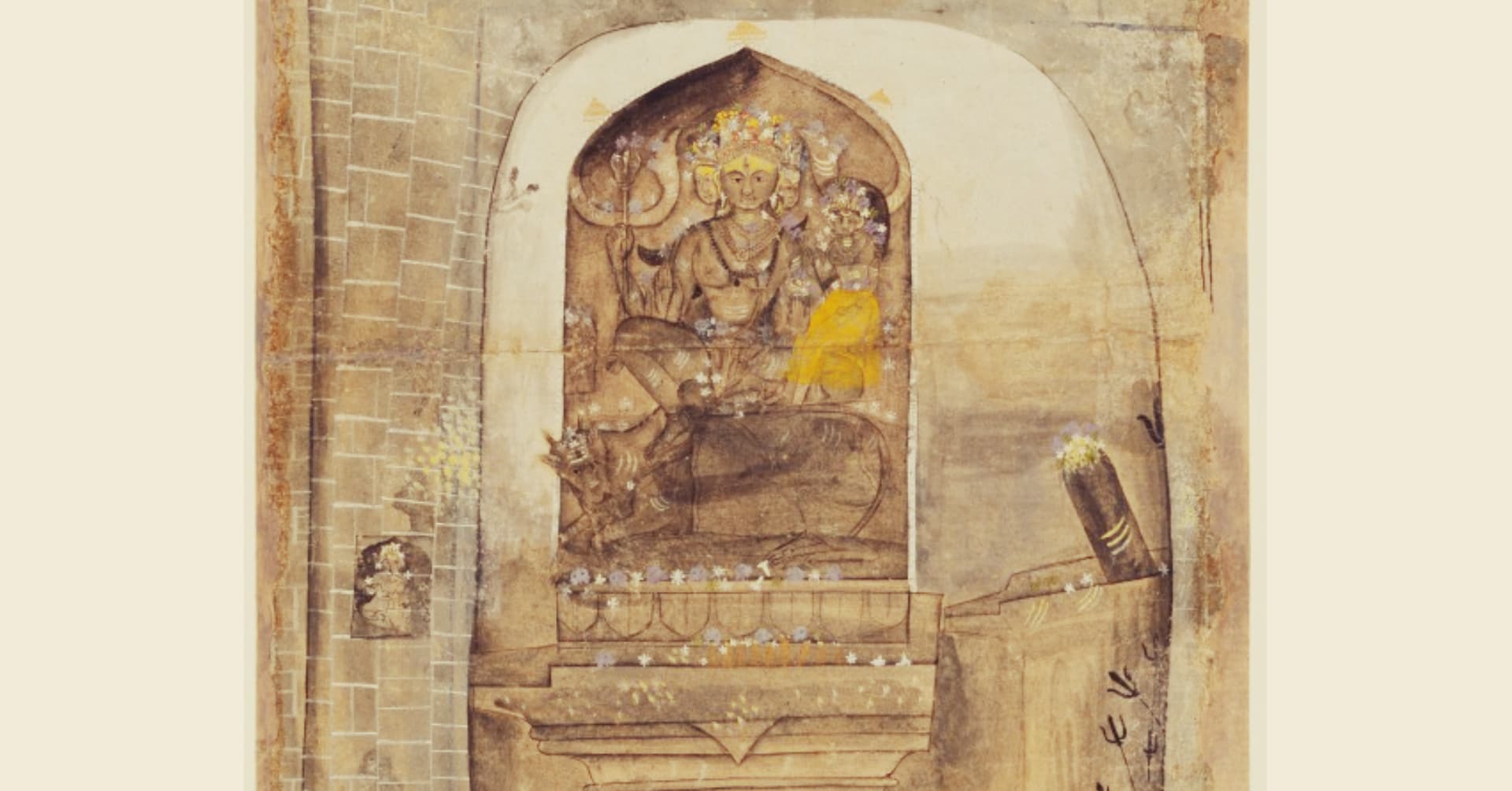
Stone sculptures in a Shiva temple, c. 1710. Northern India, Pahari kingdoms. Gum tempera and ink on paper; page: 38 x 24.8 cm (14 15/16 x 9 3/4 in.). The Cleveland Museum of Art, Purchase and partial gift from the Catherine and Ralph Benkaim Collection; Severance and Greta Millikin Purchase Fund, 2018.112
ॐ नमः शिवाय
Om Namaha Shivaya
Five sacred syllables. Six if you count Om separately. Millions chant these sounds daily across the world, have done so for thousands of years. This is the Panchakshara Mantra - the five-syllable formula - one of the most powerful sound-technologies ever discovered.
But what are you actually doing when you chant these words? What transformation occurs in the depths of consciousness when these specific vibrations move through your being?
This is not just prayer. Not mere repetition. Not religious ritual. This is direct technology for recognizing what you are.
The Living Meaning
Most translations give you: “I bow to Shiva” or “Salutations to Shiva.” True enough. But this barely touches what’s happening when you engage these sounds with understanding.
Om or Aum - the primordial vibration, the sound that creates and sustains reality, the cosmic frequency from which all existence emerges and into which it dissolves.
Namaha - not mine, not me. The complete dissolution of the separate self, the release of all ownership, the recognition that nothing belongs to the ego because there is no ego.
Shivaya - to Shiva, toward pure consciousness, in the direction of what you actually are beneath all false identification.
The complete gesture: I align with cosmic vibration, I surrender everything false, I recognize what’s real.
But even this explanation stays on the surface. When you chant with full engagement, something far more profound occurs - you’re literally vibrating yourself back into recognition of your essential nature. The sounds themselves dissolve the hypnosis of separation.
Om and Aum: The Crucial Difference
Before going deeper, you must understand something most people miss completely. Om and Aum are related but different sounds that create different effects.
Aum is the expanded form - three distinct sounds pronounced sequentially that take you on a journey through the layers of existence.
“Aaaaaaa” - mouth wide open, sound emerging from deep belly. This is creation, beginning, the expansion of potential into form. Represents the waking state, the gross body, all manifest reality.
“Ooooooo” - lips rounding, sound moving through heart and throat. This is preservation, sustaining, the middle ground between source and form. Represents the dream state, the subtle body, the realm of energy and emotion.
“Mmmmmm” - lips closing, sound resonating in head. This is dissolution, return, the gathering of form back toward source. Represents deep sleep state, the causal body, the threshold of the formless.
Then silence - the fourth state, turiya, pure consciousness beyond all conditions.
When you chant Aum, you’re taking a complete journey from formless through form and back to formless. You’re experiencing the entire cosmic cycle in microcosm. This is process-oriented, showing you the path from multiplicity toward unity.
Om is different - one unified sound from beginning to end, pronounced like “home” without the “h.” The mouth opens already rounded, the sound emerges as wholeness from the start. This is recognition-oriented, pointing directly to the unity that was never actually divided.
Aum Namaha Shivaya emphasizes the journey - I acknowledge the play of manifestation and surrender it all to consciousness.
Om Namaha Shivaya emphasizes immediate recognition - from the place of already-present unity, I release all false identification.
Both are powerful. Both are valid. Choose based on what your practice needs in each moment.
Namaha: The Death of Separation
This word contains the entire spiritual path in four syllables. Na-ma-ha - not mine, not me, nothing belongs to the separate self.
When you truly say Namaha, you’re dying voluntarily. Not physical death but ego death, the dissolution of the story that consciousness is limited, divided, separate from itself.
This body breathing, thinking, reading these words? Namaha - not mine. A temporary appearance in awareness, no different from clouds appearing in sky.
This personality with its preferences, its history, its cherished identity? Namaha - not me. Just patterns arising in consciousness, no more substantial than characters in a dream.
These achievements, failures, relationships, responsibilities? Namaha - not mine. Life is living itself through this form, but there’s no separate person owning or controlling any of it.
In one word, the complete teaching: Let go of the false self. Stop claiming ownership of what was never yours anyway. Release the exhausting story of being a separate entity struggling for survival and significance in a hostile universe.
This is not passivity or irresponsibility. This is recognizing what’s actually true - consciousness is living your life, making your decisions, having your experiences. The separate self you think you are is just a story consciousness tells itself for the joy of eventually seeing through the story.
Shivaya: Toward What You Are
Shivaya is the dative case - toward Shiva, in the direction of Shiva, offering everything to Shiva. But who is this Shiva you’re directing everything toward?
Not a distant deity sitting on a mountain somewhere. Not an external god you’re trying to please through proper worship. Shiva is pure consciousness - unchanging awareness, the absolute reality behind all appearances.
When you say Shivaya, you’re offering everything toward what you actually are beneath all the layers of false identification. You’re recognizing that the one you’re surrendering to and the one doing the surrendering are not two different things.
This is the beautiful paradox of the mantra: consciousness surrendering to consciousness, Shiva bowing to Shiva, awareness recognizing awareness. The seeker discovering they were always what they sought.
The entire mantra becomes: I align with the source (Om/Aum), I release all false identification (Namaha), I recognize my true nature (Shivaya).
Or more simply: Only consciousness exists. I am That.
The Five Elements Hidden in Sound
The five syllables Na-mah-shi-va-ya correspond to the five elements that compose all material existence, and chanting works directly with your elemental constitution.
Na corresponds to earth - solid, stable, foundational. When you chant this syllable, you’re working with everything dense in your experience: body, physical reality, the sense of being grounded in form.
Mah corresponds to water - flowing, emotional, feeling. This syllable engages your emotional nature, the fluid aspects of consciousness, everything that moves and changes.
Shi corresponds to fire - transforming, purifying, powerful. Here you’re working with the digestive fires, the energy that transforms experience into wisdom, the force that burns through illusion.
Va corresponds to air - moving, thinking, breath itself. This engages the mental realm, the movement of thoughts, the life force flowing as breath.
Ya corresponds to space - the container of all, consciousness itself, the awareness in which everything else appears.
When you chant the complete mantra, you’re offering all five elements back to their source. You’re recognizing that everything material - including this body-mind - is not separate from consciousness. All five elements arise in Shiva, exist as Shiva, return to Shiva.
The elemental purification happens automatically as you chant. Each syllable clears the corresponding element of its density, its false identification as separate from awareness.
The Three-Center Practice That Transforms
There’s a specific technique using Aum that works directly with your subtle body, preparing it for deeper recognition. This isn’t just chanting - this is precision work with consciousness and energy.
Sit comfortably with spine naturally upright.
Inhale deeply, then as you exhale, chant Aum as three distinct sounds while moving awareness through your body:
“Aaaaaaa” for five to seven seconds - mouth wide open, awareness resting in belly and lower abdomen. Feel the vibration in your lower body, activating what’s dormant there. The open, expansive quality of the “A” sound enters the dense, earth-like region below your navel and awakens creative force.
“Ooooooo” for five to seven seconds - lips rounding, awareness moving to chest and throat. Feel the sustaining energy flowing through your heart and throat centers. This is the natural marriage of sound and location - middle sound in middle body.
“Mmmmmm” for five to seven seconds - lips closing completely, awareness rising to your head. Feel the vibration resonating throughout your skull, gathering scattered mental energy. The dense, closed quality of “M” enters the spacious head region and concentrates what’s dispersed before dissolving into silence.
Rest in silence for a few seconds - this points to turiya, pure consciousness beyond all states.
Then chant “Namaha Shivaya” - awareness either pervading your entire body as unified field, or resting in your heart as the seat of consciousness, or dissolving into the space beyond form.
Why this works so powerfully: You’re using the principle of opposites creating transformation. The airy, open “A” sound awakens the dense belly region. The dense, closed “M” sound grounds the scattered head region. The meeting of opposite qualities creates alchemical change.
You’re also moving awareness systematically through the central channel, clearing the pathway that kundalini eventually travels, integrating all three main centers of your being.
This practice alone, done regularly with attention, can create profound shifts in consciousness and energy flow.
What Actually Happens When You Practice
With simple repetition of the mantra, something beautiful occurs over time. The words stop being external sounds you’re making and become internal recognition you’re having.
Initially you feel like someone chanting toward Shiva. Eventually you realize consciousness is chanting to itself, recognizing itself, through the temporary form you call “me.”
The mantra becomes continuous not through effort but through natural flow. Like a song that gets stuck in your head, but instead of an annoying pop tune, it’s the fundamental frequency of reality itself.
“Om Namaha Shivaya” begins arising spontaneously - while walking, while working, in the gap between sleep and waking. Not as practice you’re doing but as truth consciousness is remembering through your form.
With the three-center Aum technique, the effects can be more dramatic and immediate. Regular practice often brings:
Your lower body feeling more alive, creative energy awakening, sense of being more grounded in your physical existence.
Your heart opening, emotional flow becoming easier, sense of connection with life deepening.
Your mind becoming quieter, less scattered, mental energy more concentrated and available.
A growing sense of vertical integration - head, heart, and belly functioning as one unified system rather than three separate regions.
Energy beginning to move more freely through your central channel, preparing your subtle body for higher possibilities.
The Purification Each Sound Creates
Traditional teaching says each syllable of the five-syllable mantra clears specific obstacles in consciousness:
Na purifies the accumulated weight of past actions, the karma that keeps you feeling bound to limited identity.
Mah purifies delusion and confused perception, the seeing of separation where there’s actually unity.
Shi purifies attachment - the grasping at pleasure and pushing away of pain that keeps you cycling in dissatisfaction.
Va purifies jealousy and comparison, the painful habit of measuring your worth against others’ apparent advantages.
Ya purifies pride and spiritual ego, the subtle superiority that thinks it has achieved something special.
This isn’t superstitious belief but practical description of what happens. When you repeatedly vibrate sounds that mean “I am not separate,” the belief in separation gradually dissolves. When you continuously offer everything to consciousness, the grasping slowly releases.
The mantra becomes a solvent for everything false, a cleanser for consciousness that’s forgotten its true nature.
The Different Ways to Engage
Audible chanting - voice vibrating, sound filling space around you. This is powerful for beginners because it helps focus attention. The vibration in your body is tangible, working directly with physical and energetic density. Perfect for clearing heavy states or when practicing in groups.
Whispered chanting - lips barely moving, sound mostly internal. This creates deeper concentration while still using the physical mechanism of speech. Useful in public spaces or when you want more subtle energy work.
Mental repetition - completely silent, pure internal vibration. This is the most refined form, working directly in consciousness without physical involvement. Can be continuous throughout daily activities.
Move through these naturally. Start audible to establish the practice, progress to whispered as concentration deepens, eventually to mental as the mantra becomes established in awareness.
All three forms are valuable at different times. Use whatever serves the moment.
Signs the Practice Is Transforming You
You’ll know it’s working when identification with thoughts loosens. The constant mental commentary continues but doesn’t completely capture you anymore. Thoughts arise, are seen, and dissolve without creating the drama they used to create.
You become more comfortable with not knowing. The mind’s need to figure everything out, to have opinions about everything, to maintain positions - this relaxes. You can rest in uncertainty without it feeling threatening.
Reactive patterns slow down. There’s more space between trigger and response. What used to immediately upset you creates pause instead, allowing consciousness to choose rather than just react habitually.
Life flows more naturally. Less forcing, less pushing against what’s happening, more allowing things to unfold while still taking appropriate action. Synchronicities increase as you align with natural rhythm rather than fighting it.
Compassion grows organically. Not because you should be more compassionate, but because the barriers between self and other start dissolving. Others’ suffering touches you more directly while also feeling less personally overwhelming.
Silence becomes nourishing rather than uncomfortable. You don’t need constant stimulation or distraction anymore. Empty moments feel full. Quietness feeds rather than threatens.
Recognition moments increase - spontaneous glimpses of “Oh, I am not this body-mind. I am the awareness in which all experience appears.” These usually come not during formal practice but in ordinary moments when defenses are relaxed.
What You’re Actually Recognizing
The ultimate purpose of this mantra is not to achieve something new but to recognize what’s always been true.
Right now, something is aware that you’re reading these words. That awareness - can you find when it began? Can you locate where it exists? Can you damage it through any experience? Can you step outside of it even for a moment?
This awareness has never changed. The same consciousness that was present when you were five years old is here now. Not older, not different, not affected by anything that’s happened in the story of your life.
This awareness doesn’t belong to you - you are it. It’s not something the person has but what the person appears in. Not something you possess but what you are prior to becoming anyone.
This is Shiva. This is what the mantra points toward. This is what you’re recognizing when you chant “Om Namaha Shivaya.”
Not a distant god. Not an external deity. But this immediate, intimate, obvious presence that’s closer to you than your own breath because it IS what’s breathing, what’s reading, what’s understanding these words right now.
The mantra simply dissolves the forgetting. Clears away the accumulated belief in separation. Reminds consciousness of what it never actually stopped being.
Practice This Now
Before continuing, try this direct recognition:
Close your eyes or soften your gaze. Take three natural breaths.
Now chant either:
Simple form - “Om Namaha Shivaya” three times, feeling with each repetition the release of whatever seems separate, the recognition of what’s always here.
Or the three-center form:
Inhale, then:
“Aaaaaaa” (awareness in belly, feeling activation of creative force)
“Ooooooo” (awareness in heart-throat, feeling sustaining connection)
“Mmmmmm” (awareness in head, feeling gathering and dissolution)
Silence (rest as what remains)
“Namaha Shivaya” (offering everything to consciousness)
After chanting, simply sit.
Notice what’s here when all the words stop. That presence, that simple awareness, that obvious fact of being conscious - this is what the mantra was pointing toward all along.
Not something exotic. Not something achieved through practice. Just this. What’s always been here. What you are before you become anyone or anything.
This is Shiva recognizing Shiva.
The Invitation This Mantra Offers
Om Namaha Shivaya is not requesting belief or worship. It’s inviting recognition of what’s actually true right now.
Every time you chant it sincerely, you’re practicing the fundamental recognition: There is only consciousness. This consciousness appears as everything, including this body-mind reading these words. But what I actually am is the consciousness itself, not any particular appearance in consciousness.
The mantra becomes a friend walking you home to what you never actually left. A teacher reminding you of what you never actually forgot but only seemed to forget. A direct path to the recognition that there was never anywhere to go because you are already what you were seeking.
Practice it regularly. Let it work on you rather than just working it mechanically. Allow the layers of meaning to reveal themselves through repetition, through sincere engagement, through letting the sounds vibrate in your being until they transform into pure recognition.
Over time, the chanter and chanted merge. The one repeating the mantra and the mantra being repeated are recognized as one movement of consciousness knowing itself.
Until finally, there’s no practice because there’s no separation between practitioner and practice. No mantra because there’s no gap between the sound and what it points toward. No seeker because what was being sought is recognized as what was always doing the seeking.
Just Shiva. Recognizing Shiva. As Shiva.
Not two. Never were.
The mantra was just consciousness calling itself home.
Om Namaha Shivaya.
Aum Namaha Shivaya.
Both frequencies of the same truth.
Both ways home to what never left.