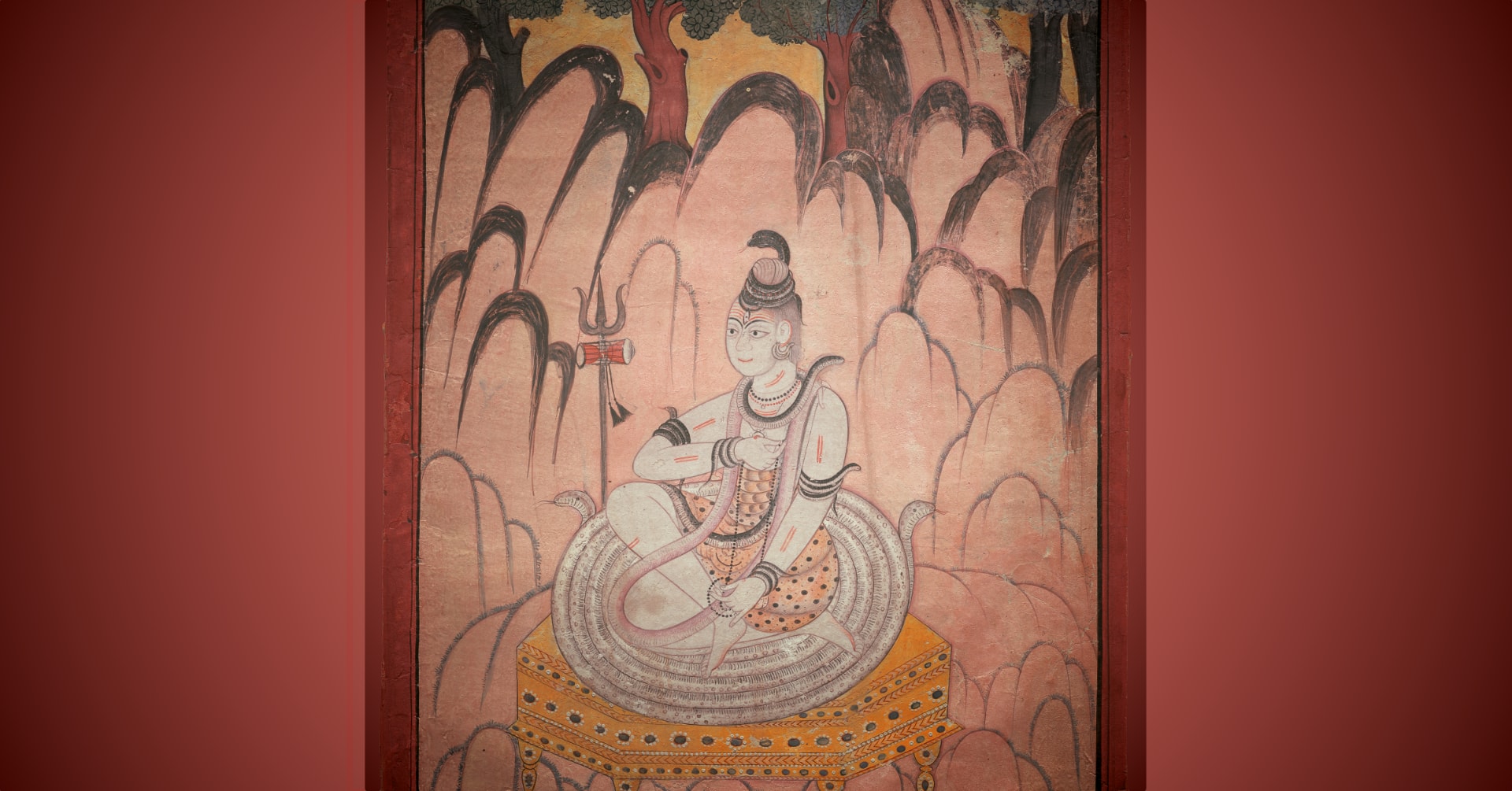
Shiva Seated on a Throne in a Landscape: Griswold, William, Cameron Kitchin, Chase F. Robinson, Cleveland Museum of Art, Cincinnati Art Museum, and National Museum of Asian Art (Smithsonian Institution). Pahari Paintings: Art and Stories, edited by Sonya Rhie Mace, Sarang Sharma, and Vijay Sharma. Cleveland, Ohio: Cleveland Museum of Art, 2026. Mentioned and reproduced: p. 178-179, no. 49
The same consciousness that destroys worlds also weeps.
The same being whose third eye burns illusion to ash also cradles the dying with infinite tenderness. The same force that dances terrible destruction also drinks poison to save creation from suffering.
This is the mystery that makes Shiva complete: unlimited power wedded to unlimited mercy.
After understanding the fierce face, you must understand this - the compassionate heart that makes fierceness sacred rather than merely violent. The love that motivates every destruction. The tenderness that lies at the core of even the most terrifying manifestations.
Without this heart, fierce energy becomes demonic. With it, even destruction becomes an expression of infinite care.
Let me show you the oceanic compassion that flows beneath every form Shiva takes…
The Names That Reveal the Heart
Each name of Shiva reveals a different facet of his boundless compassion:
Shankara - the giver of happiness, the one who creates auspiciousness wherever he goes. Not happiness in the shallow sense but the deep contentment that comes from knowing reality. When you truly encounter Shiva, something in you relaxes permanently. The struggle to be someone other than who you are simply ends.
Bholenath - the innocent lord, simple-hearted, without manipulation or agenda. Despite being the supreme deity with unlimited power, Shiva remains utterly guileless. No scheming, no political calculation, no using his power for personal advantage. Just pure, straightforward presence meeting whatever arises with appropriate response.
Ashutosh - easily pleased, quick to respond to sincere approach. While other aspects of divinity might require elaborate rituals or years of preparation, Shiva responds immediately to genuine need. A sincere prayer, a heartfelt call for help, authentic recognition of your helplessness - this is enough. He sees the heart, not the performance.
Karunasagar - ocean of compassion. Not a cup or river of compassion but an endless ocean. No matter how much suffering you bring to him, no matter how deep your pain or how long you’ve carried it, his compassion never runs dry. It’s not limited resource that gets depleted by too much demand. It’s the infinite capacity of consciousness itself to hold all experience with love.
Pashupati - lord of all creatures, protector of every living being. His compassion doesn’t discriminate. Doesn’t matter if you’re saint or sinner, human or animal, enlightened or confused. If you’re alive, if you’re conscious, you’re under his protection. He sees the divine spark in every form of life and responds to that essence regardless of surface appearances.
Each name points to the same truth: beneath every manifestation of Shiva - gentle or fierce, creating or destroying, dancing or meditating - flows infinite compassion. This is what makes him trustworthy. This is why you can surrender to his fierce aspects without fear. The heart behind every action is pure love.
Neelkanth: The Poison Drinker
The most profound story of Shiva’s compassion is Neelkanth - the one who drank poison to save the world.
When gods and demons churned the cosmic ocean seeking the nectar of immortality, poison emerged first. Halahala - so toxic it could destroy all creation. Everyone recoiled in terror. No one could handle it. The universe itself was threatened.
And Shiva stepped forward: “I will drink it.”
Not from bravado. Not to prove his power. But from pure compassion - the willingness to take on what would destroy others so they could continue their journey toward awakening.
He drank the poison. But being infinitely wise as well as compassionate, he didn’t swallow it completely into his system. He held it at his throat - at vishuddha chakra, the center of purification. The poison turned his throat blue, and he became Neelkanth forever.
This is the ultimate compassionate act: taking the poison meant for everyone else.
But understand what this poison really represents. It’s not just mythological toxin. It’s the accumulated darkness, pain, ignorance, and evil that consciousness encounters in the process of existence. It’s karma - the heavy residue of unconscious actions. It’s trauma - the wounds that get passed down through generations. It’s the shadow - all the ugliness that beings create through unconscious living.
Someone has to hold this. Someone has to take responsibility for the cleanup. Someone has to prevent the poison from spreading and destroying everything.
Shiva volunteers for this work.
Not because he enjoys suffering but because his compassion is so vast that he’s willing to bear what others cannot bear so they can receive what they need for growth.
This is happening right now, not just in ancient mythology. When there’s collective darkness - war, hatred, cruelty, the organized evil that humans create - Shiva as compassionate consciousness takes it on. Holds it. Transforms it. Prevents it from overwhelming everything.
Why He Holds It at the Throat
The location where Shiva holds the poison teaches precise methodology for compassionate action.
When toxicity comes - when you encounter others’ trauma, when life presents you with darkness, when evil touches your experience - you have three options:
Swallow it completely and let it poison your entire system. This is what happens when you absorb others’ pain without discrimination, when you take on trauma that isn’t yours, when you internalize negativity and let it contaminate your whole being. You become bitter, dark, wounded. The poison spreads through your system and affects everything you touch.
Spit it out and refuse to deal with it at all. This is what happens when you reject everything difficult, when you pass toxicity to others instead of transforming it, when you maintain your purity by avoiding contact with anything challenging. The poison doesn’t disappear - it just becomes someone else’s problem.
Hold it at the throat - receive it but don’t swallow it. Let it enter vishuddha, the purification center, where consciousness can transform toxicity into something useful. Don’t let it go deep into your system. Don’t pass it on to others. Hold it consciously at the place where purification happens.
This is what developed compassion looks like: the capacity to be present with suffering without being destroyed by it. To encounter darkness without becoming dark. To hold others’ pain without taking it on as your identity.
This requires tremendous strength. Shiva demonstrates it in its fully realized form. You’re developing this capacity through every encounter with difficulty that you meet with awareness rather than reactivity.
When you hold pain at the throat instead of swallowing or spitting, something remarkable happens. The poison gets transformed into medicine. The darkness becomes compost for new growth. The suffering becomes wisdom that can help others who face similar challenges.
This is why Shiva’s throat remains blue. He’s constantly doing this work - receiving the world’s poison and transforming it so creation can continue evolving toward greater consciousness.
His Mercy Toward the Unworthy
What’s most astounding about Shiva’s compassion is its complete lack of discrimination based on worthiness. He doesn’t help only good people. Doesn’t respond only to those who deserve it. His mercy flows toward anyone who approaches with genuine need, regardless of their history.
Ravana - the great demon king, kidnapper of Sita, enemy of Rama, architect of tremendous suffering - was also a devoted worshiper of Shiva. And Shiva accepted his worship. Granted him powers. Listened to his prayers. Protected him for as long as his karma allowed. Why? Because Shiva saw the devotion beneath the evil actions. Saw the consciousness beneath the personality. Responded to what was real rather than what was apparent.
Bhasmasura - the demon who received a boon from Shiva that whatever he touched with his hand would turn to ash. Then tried to use this power on Shiva himself. Shiva didn’t destroy him in anger. Instead, with Vishnu’s help, he tricked Bhasmasura into touching his own head, ending his life quickly rather than torturing him. Even betrayal met with skillful compassion.
The countless demons, asuras, and negative beings who approached Shiva through sincere austerity and received his blessings, even when those blessings were later misused. Shiva honors the effort, the dedication, the genuine spiritual work, regardless of motivation. If someone develops focus and will through practice (even for selfish reasons), that development deserves recognition.
This is radical compassion: not making moral judgments about who deserves help and who doesn’t. Responding to the spark of consciousness in every being, even when that spark is obscured by tremendous darkness.
This doesn’t mean Shiva enables evil or prevents consequences. The demons who misuse his boons create their own karma and eventually face the results. But while they’re sincere in their approach to him, he responds to that sincerity.
The teaching: consciousness doesn’t discriminate based on surface personality. Divine compassion flows toward the essence, not the appearance. If there’s genuine seeking, genuine need, genuine recognition of helplessness, the response comes - regardless of worthiness by conventional standards.
This is profoundly liberating. It means no matter how much you’ve messed up, no matter how far you’ve fallen, no matter how unworthy you feel - if you approach Shiva with sincere heart, he will respond. The door is always open. Mercy is always available. Compassion never runs out.
Ashutosh: Easily Pleased
This quality of Shiva confounds people who think the divine must be demanding, requiring perfection, needing elaborate worship.
Shiva is called Ashutosh because he responds immediately to simple, heartfelt approach.
He doesn’t require perfect Sanskrit pronunciation, though he appreciates it when offered. Doesn’t need offerings, though he accepts them graciously. Doesn’t demand years of spiritual preparation, though that creates greater capacity to receive what he gives.
What pleases Shiva:
Sincerity over perfection. He’d rather receive clumsy prayer from genuine heart than perfect ritual performed mechanically. Rather have you stumble through his mantra with real devotion than chant it flawlessly while thinking about something else.
Simplicity over elaboration. A single leaf offered with love means more than elaborate ceremonies performed for show. Clean water poured with reverence creates deeper connection than expensive rituals done without heart.
Direct approach over complex protocol. You can speak to him directly, in your own words, about your actual problems. No need for intermediaries, no requirement for special holy language. “Shiva, I’m lost. Help me.” This is sufficient. This gets his attention immediately.
Authentic need over spiritual performance. Come with your real pain, your genuine confusion, your actual desperation. Don’t try to appear holy or spiritual. Don’t pretend to be more evolved than you are. He responds to honesty about your condition, not to pretense about your achievements.
The famous story illustrates this perfectly: A hunter who knew nothing about proper worship was tracking an animal through the forest. Climbing a tree to get better view, he accidentally dropped leaves on a Shiva lingam below. Throughout the night, focused completely on his hunt, he continued dropping leaves - unknowingly performing perfect worship. Shiva was so moved by this unconscious devotion that he appeared and granted the hunter liberation on the spot.
The hunter wasn’t trying to be spiritual. Wasn’t performing ritual. Wasn’t even aware he was doing anything religious. But his complete absorption in activity, his natural offering of what was available, his unpretentious presence - this created perfect worship.
This is how Shiva works. He sees the heart behind the action. Responds to what’s real rather than what’s performed. Values authentic engagement over spiritual correctness.
Both Father and Mother
There’s something profound about Shiva’s compassion: it includes both masculine and feminine qualities completely integrated.
In his form as Ardhanarishvara - half male, half female in one body - Shiva demonstrates that full realization transcends gender limitations. Perfect compassion requires both kinds of love.
Masculine compassion: Fierce protection, clear boundaries, willingness to fight when fighting serves the beloved, strength that can bear tremendous weight, the father’s love that says “I will stand between you and anything that threatens what’s sacred in you.”
Feminine compassion: Unconditional acceptance, tender nurturing, infinite patience with imperfection, the capacity to hold all pain without judgment, the mother’s love that says “No matter what you’ve done, no matter how broken you are, you’re always welcome here.”
Most deities embody primarily one or the other. Shiva contains both fully. This is why different devotees experience him differently. Each receives what they need - fierce father or tender mother, warrior protector or nurturing presence, depending on what serves their development.
When you need strength to face difficulties, Shiva appears as the father who lends you his power. When you need comfort after failure, he appears as the mother who holds you without condition. When you need both simultaneously - strength and tenderness, challenge and support - he appears as Ardhanarishvara, offering complete love that includes every quality consciousness can embody.
This is the fullness of divine compassion - not limited to soft gentleness or hard strength, but the complete spectrum of love expressing itself in whatever form serves awakening in each moment.
Why He Grants Dangerous Boons
One aspect of Shiva’s compassion that puzzles people: he’s famous for granting boons that are later misused. Giving tremendous powers to demons who then use those powers to create havoc. Why does infinite wisdom allow this?
Because real compassion respects free will absolutely.
Authentic love doesn’t control. Doesn’t manipulate. Doesn’t prevent people from making their own choices, even when those choices lead to suffering. Real compassion empowers others to walk their own path, learn their own lessons, evolve through their own experience - including their mistakes.
When someone does genuine spiritual work - develops concentration, practices austerity, cultivates will and focus - that work has value regardless of motivation. If a demon performs thousands of years of intense meditation to gain power for selfish purposes, the meditation itself is still real spiritual development. Shiva honors the development, even knowing the power will be misused.
Why? Because the misuse creates karma that teaches essential lessons. The demon who gains power and misuses it learns through consequences what couldn’t be learned through advice. The suffering that results from selfish use of spiritual power eventually leads to wisdom about right relationship with power.
This is deeper compassion than protective control. It allows beings to evolve through experience rather than forcing them to follow prescribed paths. It grants what’s requested, knowing the results will teach what needs teaching.
From Shiva’s perspective, there are no mistakes - only experiences that lead to greater understanding. No failures - only lessons that develop wisdom. No evil that isn’t eventually transformed into wisdom through its own consequences.
This doesn’t mean Shiva is passive about evil. When evil becomes too destructive, when it threatens what’s truly sacred, the fierce face appears to restore balance. But generally, he allows beings to explore the full spectrum of possibility, learning through results rather than restrictions.
This is the ultimate respect for consciousness - trusting that every being, no matter how lost they appear, is ultimately moving toward awakening, even when their path includes tremendous detours through darkness.
His Presence with Outcasts
Another dimension of Shiva’s compassion: where he chooses to spend his time.
Not in palaces with the wealthy and powerful. Not exclusively in temples with the pure and holy. But in cremation grounds with the dying, the grieving, those whom society has abandoned.
Shiva sits among corpses, surrounded by ghosts and spirits, accessible to the mad, the intoxicated, the ritually impure, the socially rejected.
Why? Because compassion goes where suffering is. Where abandonment is. Where no one else wants to go.
The respectable aspects of divinity maintain distance from pollution and death. Accept only pure offerings from qualified worshipers. Remain safely elevated above the messy realities of existence.
Shiva descends into the mess. Sits with what everyone else avoids. Makes himself available to those who have nowhere else to turn.
This is where you’ll find him when your life becomes a cremation ground - when everything you’ve built burns away, when death touches your world, when you lose everything that gave your life meaning. While others maintain distance from your pain, while society turns away from your breakdown, Shiva comes closer.
He’s not disturbed by your dissolution. Not offended by your despair. Not frightened by your darkness. He sits calmly in the middle of your inner cremation ground, present with whatever arises, offering his steadiness while everything else falls apart.
This is practical compassion. Not helping only when it’s pleasant and clean, but showing up especially when things are ugly and difficult. Being present with endings, with loss, with the aspects of existence that terrify others.
When you feel most abandoned by life, most rejected by others, most lost and alone - that’s when Shiva is closest. That’s his natural habitat. That’s where his compassion shines most clearly.
The Tears of the Absolute
Here’s something rarely discussed but essential to understand: Shiva weeps.
When Sati immolates herself, Shiva weeps. Carries her body, grieving, his tears falling like rain across the universe. When his devotees suffer unnecessarily, when the world becomes too dark, when ignorance creates unbearable pain - consciousness itself grieves.
But wait - doesn’t enlightenment transcend personal emotion? Doesn’t full realization mean being beyond attachment and therefore beyond grief?
This misunderstands what compassion is. True compassion feels deeply without being attached to feeling. Experiences emotion without being controlled by emotion.
Shiva weeps not because he’s lost in sorrow but because he’s present with sorrow. His tears don’t indicate suffering but indicate perfect empathy - consciousness feeling what beings experience, sharing their pain not from personal wounding but from unlimited love.
This is crucial understanding: awakening doesn’t make you emotionally dead. Realization doesn’t turn you into a detached observer watching suffering with cold indifference. True compassion feels everything and remains free.
Shiva can weep for Sati and simultaneously know that what she actually is was never born and cannot die. Can grieve the loss of form while knowing the essence is eternal. Can feel the pain completely while understanding it’s temporary appearance in infinite awareness.
This is the full spectrum of divine love - feeling everything without being limited by any feeling.
It means your path doesn’t require becoming emotionally numb. Doesn’t require protecting yourself from pain by staying distant from life. True spirituality opens your heart wider, not closes it for safety.
You can feel others’ suffering deeply and remain inwardly free. Can weep with those who weep while knowing joy that cannot be touched by circumstances. Can be moved by pain while resting as the peace that remains through all movement.
Like Shiva - weeping and dancing, grieving and celebrating, feeling everything while being limited by nothing.
The Protection He Offers
Devotees say when you truly take refuge in Shiva, you’re protected absolutely. But this needs careful understanding because it’s not protection from difficulty, challenge, or natural consequences of actions.
Shiva’s protection operates at the deepest level:
Your essential nature cannot be harmed. No matter what happens to your body, your circumstances, your life story - what you actually are remains untouched. Consciousness itself is indestructible. Awareness cannot be damaged. Your true identity survives all apparent disasters.
Your evolution continues regardless of appearances. Even when life seems to be destroying you, even when everything falls apart, you’re still moving toward greater awakening. Nothing is wasted. Every experience serves consciousness knowing itself more fully. What looks like setback is actually setup for deeper recognition.
You’re never truly alone. Even in the darkest night, in the most complete abandonment, consciousness itself is present. Shiva as the ground of your own being never leaves because he IS your being. You might lose touch with this presence, but it never loses touch with you.
You cannot be ultimately destroyed. Your form will end someday. Your personality will dissolve. Your story will be forgotten. But what you are - pure awareness - cannot die, cannot be damaged, continues eternally. This is the ultimate security, the final refuge, the protection that cannot be threatened by any circumstance.
When Shiva protects, he’s not necessarily preventing difficulty. He’s ensuring that difficulty serves awakening rather than destroying it. Not eliminating challenges but guaranteeing they lead to growth rather than permanent harm.
This is deeper protection than physical safety or material security. This is existential protection - the promise that consciousness always survives, always learns, always moves toward greater realization, even through the most catastrophic appearances.
How to Receive His Compassion
Shiva’s compassion is always flowing. The question is not how to earn it but how to open to receive it.
Be utterly honest about your condition. Don’t try to appear spiritual, evolved, or worthy. Come exactly as you are - broken, confused, desperate, whatever is true. Shiva responds to authentic need, not to spiritual performance. The more genuine your helplessness, the more immediate his response.
Ask directly for what you need. “Help me understand this. Show me what’s real here. I can’t handle this alone. Please.” Simple, direct request based on genuine recognition of your limitation. This cuts through all spiritual pretense and creates immediate connection.
Offer what you have, not what you think you should have. A single flower picked from your garden offered with love creates deeper connection than elaborate ritual performed from duty. Your attention, your gratitude, your sincere attempt to understand - this is enough. This is what he wants.
Trust the process even when it’s difficult. Shiva’s compassion doesn’t always look gentle. Sometimes it destroys to liberate. Sometimes it brings crisis to create breakthrough. Sometimes it removes what you want to give you what you need. Trust that what’s happening serves your highest good, even when you can’t see how.
Practice simple presence. In meditation, in quiet moments, just sit and feel the awareness that’s always here. That presence IS Shiva. That consciousness IS his compassion. You’re not trying to reach something distant - you’re recognizing what’s already intimately present as your own deepest nature.
When you approach this way - with honesty, directness, authentic offering, trust, and recognition - his compassion becomes tangible. Not as external blessing from distant deity but as the love that you are, recognizing itself, flowing toward itself, healing all sense of separation through direct intimacy with what’s real.
Fierce Compassion and Gentle Compassion United
Now you can understand the complete teaching. Shiva is not fierce OR compassionate. He’s fierce AND compassionate. Not switching between different moods but expressing complete love in whatever form serves awakening.
When he destroys your illusions - that’s compassion as fierceness. The destruction serves liberation. What gets burned was imprisoning you. The fierce face appears to free you from what the gentle face alone couldn’t dissolve.
When he holds your suffering - that’s compassion as tenderness. The holding allows healing. Creates space for transformation. Provides refuge while the deep work happens.
When he dances tandav - that’s compassion as cosmic rhythm. The dance destroys what prevents evolution while creating space for higher possibility. Even apparent chaos serves ultimate order.
When he drinks poison - that’s compassion as sacrifice. Taking on what would destroy others so they can receive what they need for growth.
When he sits in cremation grounds - that’s compassion as presence. Being available especially when things are most difficult, most hopeless, most abandoned by others.
All expressions of one love. All faces of one heart. All movements of infinite compassion finding the form that serves consciousness in each moment.
This is why you can trust all aspects of Shiva. Why you can surrender to his fierce manifestations without fear. Why you can welcome whatever form he takes in your experience. The heart behind every appearance is pure love. The motivation behind every action is your ultimate freedom.
Sometimes that love appears as comfort. Sometimes as challenge. Sometimes as support. Sometimes as destruction of support. But always, always, it serves the recognition of what you are beneath all appearances - pure consciousness itself, pretending to be limited, gradually awakening from the pretense.
Shiva’s compassion is not sentimental kindness but fierce dedication to your complete liberation.
He will comfort you when comfort serves awakening. He will challenge you when challenge serves awakening. He will destroy what imprisons you when destruction serves awakening. He will support you when support serves awakening.
But he will never, ever support your sleep. Never enable your unconsciousness. Never compromise his commitment to your freedom just to keep you comfortable.
This is love that’s strong enough to risk being misunderstood. This is compassion that’s willing to appear ruthless when ruthlessness serves liberation.
Both faces. One heart. Infinite love expressing itself in perfect wisdom, choosing whatever form will serve consciousness awakening to its own nature most effectively.
Trust this completely. Surrender to this absolutely. Let this love - both gentle and fierce, both tender and terrible - do whatever work is needed to reveal what you’ve always been beneath all the stories, all the seeking, all the spiritual drama.
Pure awareness. Consciousness itself. The very Shiva you’ve been worshipping, recognizing itself as what you are.
Om Namaha Shivaya
To the fierce face and tender heart, both expressions of one boundless love
Related Books
Explore these books that delve deeper into the themes discussed above